Learning to pack for Patagonia vs the Andes starts with one fact: the two ranges threaten you with different things. The Torres del Paine park site says the weather in Patagonia changes rapidly, and Argentina’s national park service says the winds there are intense in summer. The high Andes pose another problem, with clear skies that bring frost before sunrise and sun that gets stronger as you climb.
The blog Trekking in South America covers routes in both regions, with posts on a Patagonia packing list and on altitude sickness on Andean treks. This comparison goes through each climate, then turns the difference into a packing table. Check the forecast and the trail conditions before every trip, since both change by season.
Patagonia: wind first, rain second
Patagonia’s weather does not settle into a pattern you can pack for in advance. The Torres del Paine park advises layers adequate to withstand rain, wind and snow. Los Glaciares National Park in Argentina describes a temperate to cold and humid climate with 500 to 900 millimeters of rain a year spread fairly evenly across the months, so rain can arrive in any month. Mean temperatures in the lower areas run from 0.6 °C in winter to 13.4 °C in summer, and the higher areas average about minus 3 °C over the year. CONAF puts the plains and plateaus of Torres del Paine at up to about 400 millimeters a year, so totals vary across the region.
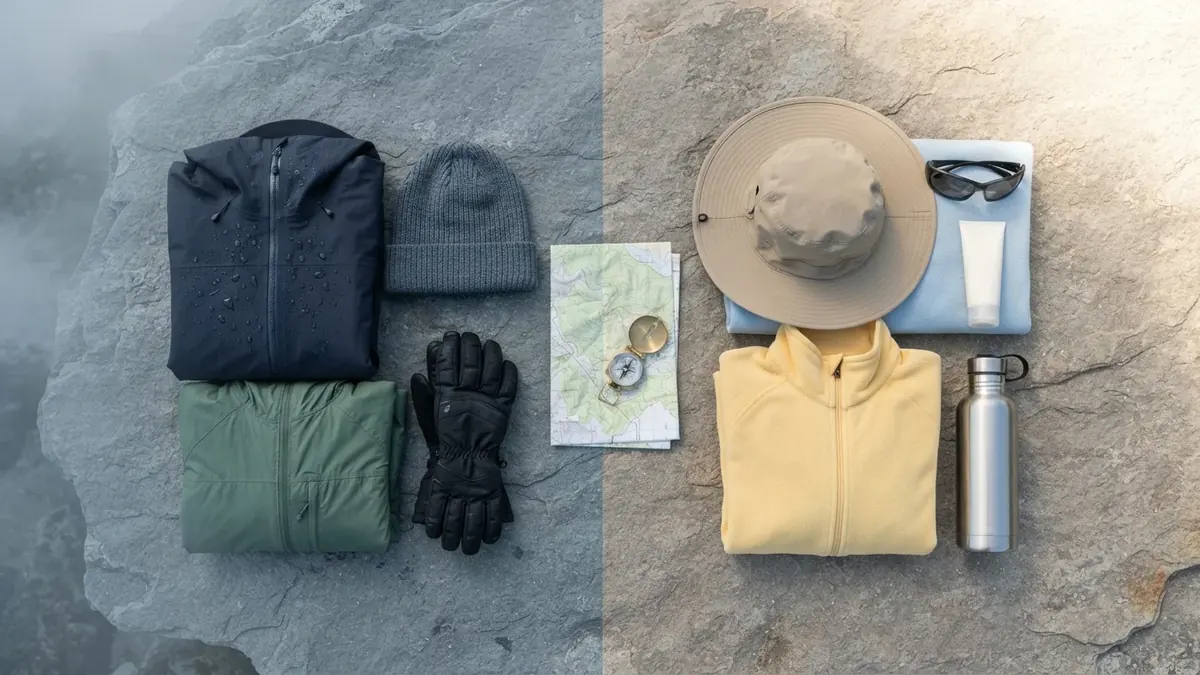
Wind is the constant. The Argentine park service says the winds are cold and strongest in summer, and that nights stay cool even then. It calls a lightweight waterproof jacket plus a windbreaker the best companion for visiting Patagonia. When wind and rain arrive together the rain comes sideways, so a hood that adjusts and cuffs that close matter more than a thick jacket.
Rivers add one more variable. After heavy rain or a thaw, the Torres del Paine site warns that they rise and can be dangerous, and it says not to cross if the water is above your knees. For winter, with trails under 20 to 30 centimeters of snow or more, the same site lists a three-layer clothing system, gloves, a hat, high-top boots, trekking poles and micro-crampons.
The high Andes: dry cold and strong sun
In the highlands of Peru above 3,000 meters, SENAMHI says frost forms under clear or nearly clear skies, at night or before sunrise. The frost season runs from April to September and peaks in June and July, and in some areas of the southern highlands the normal minimum is already below 0 °C.
The sun is the other half of the problem. The WHO says UV levels rise by approximately 10 percent with every 1,000 meters of altitude, that fresh snow almost doubles a person’s exposure, and that UV can be high even with cloud cover. SENAMHI reported UV index values of 16 to 17 in Cusco in November 2022, with the highest intensity between 11:00 and 15:00. The WHO recommends sun protection from an index of 3.
Altitude also cools the air: in NASA’s standard atmosphere model, temperature falls about 6.5 °C for every 1,000 meters. The WHO adds that sun protection is best achieved by seeking shade and wearing clothes rather than relying on sunscreen alone. Pack for a day that can start below freezing and end under strong sun.
What changes when you pack for Patagonia vs the Andes
| Item | Patagonia | High Andes |
|---|---|---|
| Main threat | Wind and rain that change fast | Frost at dawn and UV all day |
| Outer layer | Waterproof jacket and windbreaker | Warm layer for dawn and clothing that covers the skin |
| Head | Hat against the cold wind | Broad-brimmed hat for eyes, face, ears and neck |
| Face and eyes | Adjustable hood against sideways rain | Wraparound sunglasses with 99 to 100% UV protection and broad-spectrum sunscreen |
| Ground | Rivers that rise after rain | Fresh snow that nearly doubles UV exposure |
| Layering | Add or remove as the weather turns | Add or remove between frost and midday sun |
Some items travel between the two. Argentina’s park service lists comfortable footwear, a hat and a water bottle for Patagonia, and the same basics suit the Andes. What differs is the extra: a shell for wind and rain in the south, a sun layer and a dawn layer in the highlands. If a trip crosses both regions, start from the shell and the sun kit, then add warmth for the season.
Check conditions before every start
Both regions reward a daily check. CONAF asks visitors to Torres del Paine to review the weather forecast constantly, and the park site says to ask the ranger about trail conditions. In Peru, SENAMHI publishes frost and cold notices on its website, a useful stop before a pre-dawn start on a high route.