Choosing Your Peak: Vinicunca vs. Palccoyo
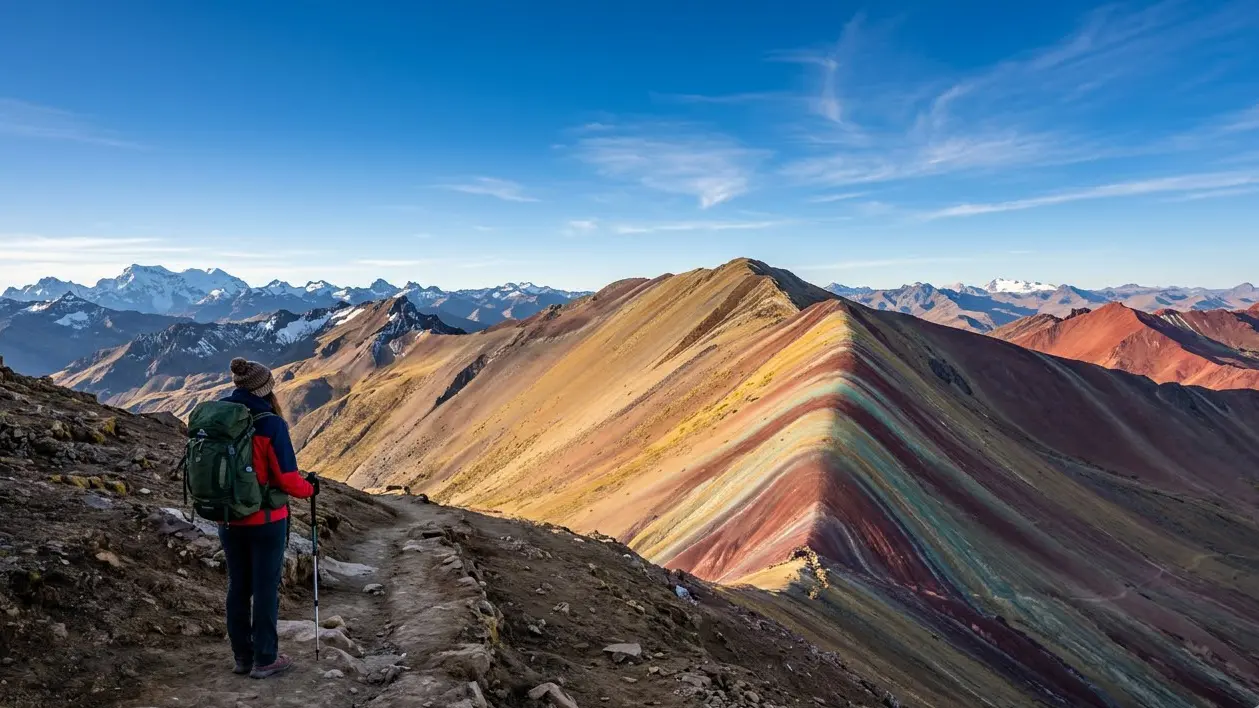
What people don’t always explain clearly is that there isn’t just one Rainbow Mountain. The one most people talk about is Vinicunca, the famous one you’ve probably seen all over social media. Then there’s Palccoyo, which shows up less often but is still very impressive in its own way. Choosing between these two already changes how your day is going to feel, not just physically but also in terms of timing and pace. They’re not interchangeable, even if from the outside they might look similar.
The Early Start and the Journey to the Trailhead
If you go with Vinicunca, you need to accept from the beginning that it’s going to be a long, kind of demanding day. Most tours pick you up around 4 in the morning, sometimes even earlier depending on where you’re staying. When the alarm rings, it doesn’t feel great, especially if you’re still adjusting to the altitude or just tired from previous days in Cusco. But that early start isn’t random. The drive alone takes around three hours, and it’s not a straight highway kind of ride. It’s winding roads, small towns, occasional stops, and usually a break for breakfast in a basic spot along the way. All of that adds up, so by the time you actually reach the starting point of the hike, it’s already mid-morning without you even realizing how the time passed.
Breathing at 5,000 Meters
Then the hiking part begins, and that’s where things slow down in a different way. The trail itself is not technically difficult, there’s no climbing or anything like that, but the altitude changes the whole experience. You’re above 5,000 meters, and your body feels it almost immediately. Breathing gets heavier, your pace drops, and you find yourself stopping more often than you normally would, even if you’re in good shape. It’s not dramatic, just constant. Like a quiet reminder that you’re not at sea level anymore. Going up can take anywhere from one and a half to two hours, sometimes more if you take it easy, which honestly is the better approach.
“It’s not technically difficult… but the altitude changes the whole experience. You’re above 5,000 meters, and your body feels it almost immediately.”
The Summit Experience and the Return Trip
Once you reach the top, you spend some time just being there. Taking photos, looking around, maybe sitting down for a bit to recover. It’s definitely a nice moment, but it’s rarely a quiet one. You’ll notice pretty quickly that many groups arrive around the same time, since most tours leave Cusco at similar hours. So instead of a silent mountain experience, it feels more shared, like a lot of people reaching the same point at once.
The way down is easier but still takes time, around an hour or so, and by then your legs start to feel it a bit. And even after finishing the hike, the day is far from over. You still have lunch somewhere on the way back, then the long drive again toward Cusco. By the time you arrive, it’s usually late afternoon or even early evening, and you can feel the length of the day in your body.
Why Timing Actually Matters
That’s why leaving early actually matters more than it seems. It’s not just how tours are organized for no reason. If you leave later, you don’t avoid the effort, you just shift the experience into a more crowded and often cloudier part of the day. Mornings tend to be clearer, with better light and stronger colors. As the day goes on, clouds often roll in, and the mountain doesn’t look quite the same. So even if waking up that early feels rough, it does make a difference once you’re there.